
Perumda Tirta Patriot reduced its clean water treatment volume on 5 August 2026 after raw water quality in the Kali Bekasi river deteriorated. The utility's Production Manager, Ahmad Giri Widodo, put the adjustment in fairly specific numbers.
“We normally treat around 500 to 600 litres per second. Right now we have brought production down to about 500 litres per second to match the raw water quality condition,” he said.
Reporting from the same period recorded raw water quality reaching class 4. For comparison, a water body fit to be treated into drinking water sits at class 1. That three-tier gap explains why the utility went as far as advising residents to use distributed water for bathing, laundry and rinsing first, rather than for drinking or cooking.
What degraded was the input, not the network
This is the part that gets mixed up most often in everyday conversation. Cloudy water at the tap reads like a pipe problem, when the cause can sit far upstream.
Kali Bekasi is the primary raw water source Tirta Patriot treats. Once that river is heavily polluted, dark in colour and strong in odour, the treatment plant faces an uncomfortable set of choices: raise the treatment dosage, lower production volume, or both. The utility went with both, adding aeration and pre-chlorination, increasing chemical dosing, and running 24-hour quality monitoring.
So that 500 litres per second figure is not a broken maximum capacity. It is an operational decision to protect output quality while the input is bad.
A treatment plant can fix a great deal, but its ability has a ceiling. The dirtier the raw water going in, the less safe water comes out in the same unit of time.
The pollution source sits outside Bekasi City
The contamination originates upstream in Bogor Regency, around the confluence of the Cikeas and Cileungsi rivers. A long dry season made it worse, because there was no rainfall diluting the pollutant load. Concentrations built up along the channel before reaching the intake point in Bekasi.
The pattern should sound familiar to anyone following flooding in the same catchment. The logic is identical, only the direction of harm changes: during heavy rain, water from the Bogor highlands arrives as upstream-sent flooding; during a long dry spell, the same channel delivers an undiluted pollutant load. One river basin, two seasons, two failure modes.
The practical consequence deserves to be stated plainly: Bekasi City Government and Tirta Patriot do not control the source of the problem. What they control is only the downstream portion of this chain.
| Link in the chain | Location | Who controls it |
|---|---|---|
| Pollution source | Upstream, Bogor Regency (Cikeas–Cileungsi confluence) | Outside Bekasi City authority |
| River flow and discharge | Along the channel | Coordinated with Perum Jasa Tirta II |
| Water intake point | Kali Bekasi | Perumda Tirta Patriot |
| Treatment plant | Bekasi City | Perumda Tirta Patriot |
| Distribution network | Bekasi City | Perumda Tirta Patriot |
| Household tank and pump | Your own unit | The occupant |
That last row is the only one entirely within your control, and it is the one most often skipped during a site visit.
Which areas requested the most help
Bekasi City's disaster agency, working with other agencies, deployed 13 water tankers to crisis points. The highest demand was recorded across two districts:
- East Bekasi — Margahayu and Duren Jaya
- North Bekasi — Harapan Baru and Teluk Pucung
Emergency water distribution status was set to continue through September 2026. This is not an overnight outage that resolves itself, then, but a recovery period measured in weeks.
Earlier, on 2 August 2026, a separate intake pump failure at the Pondok Ungu treatment plant also disrupted supply across several areas. Two incidents in one month on the same system are worth logging as a pattern rather than a coincidence.
The structural fix being pursued
Several reports in July 2026 mentioned Perumda Tirta Patriot pushing for a relocation of its water intake point to Kalimalang, shifting dependence away from Kali Bekasi toward a source with more reliable quality.
The limits of that information need stating. As of writing, no official announcement setting out a budget, project stages or a completion date could be found. So treat the intake relocation as a direction already raised in public, not as a project with a schedule you can count down to.
What to verify if you are viewing houses
Water is among the easiest topics for anyone selling something to answer in a reassuring, non-specific way. Which is why these three items are better checked yourself than asked as closed questions with predictable answers.
- Tank capacity per unit and how long it lasts. Not just the litre figure, but how many days it sustains the household size you are planning with nothing coming in. A two-storey house with two bathrooms has a different consumption profile from a single-storey one.
- Whether the estate has a backup source. A deep well serving the estate, a communal tank, or road access wide enough for a tanker truck to reach your unit. An honest comparison between piped supply, deep wells and filtration systems is more useful before signing than after moving in.
- That specific block's outage history over the past twelve months. Ask residents who already live there, not the brochure. How often it stopped, for how long, and what they did while it lasted.
If what you are dealing with is water that still flows but has changed colour or smell, the handling differs and follows its own sequence. The protocol for telling ordinary sediment apart from contamination is covered separately in our guide to cloudy and foul-smelling tap water.
What cannot be settled yet
- When raw water quality fully recovers. Recovery depends on the upstream pollutant load and on rainfall arriving, two variables no operator in Bekasi controls.
- Whether the intake relocation actually proceeds. No dated official document on budget or stages is available to cite.
- How evenly the impact lands block by block. Available data stops at the sub-district level. Water pressure can differ between blocks in the same sub-district depending on position along the network.
- The effect on property prices. No study measures that for Bekasi. Connecting the two right now would be guesswork.
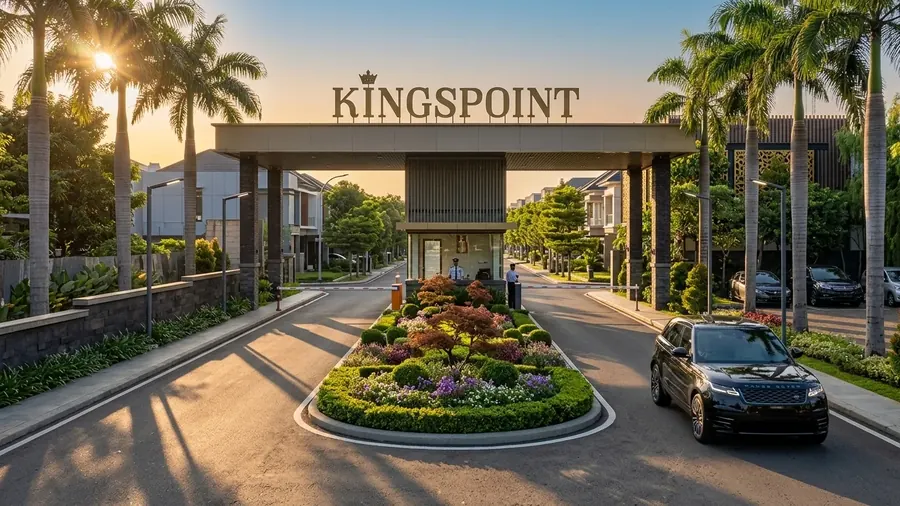
Where the Kingspoint units sit, and what can be verified
The Emerald 70 house stands on Jl. Raya Perjuangan, North Bekasi, the same district as Harapan Baru and Teluk Pucung. Its specifications can be checked on site: land area 47.25 m², building area 70 m², dimensions 4.5 m × 10.5 m, two storeys, bore pile foundation, priced from Rp 700 million including VAT, with instalments starting at Rp 5 million per month. It sits 5 minutes from Bekasi Station, 5 minutes from Summarecon Mall, and 10 minutes from the Bekasi Barat toll gate.
On water, the questions worth putting to the sales team are not yes-or-no ones but measurable ones: the estate's water source, installed tank capacity per unit, and whether the internal road allows a tanker truck through. All three can be answered with numbers and checked during a visit.
Frequently asked questions
Why did Perumda Tirta Patriot water run into trouble in August 2026?
Its raw water source, the Kali Bekasi river, was heavily polluted. Raw water quality was measured at class 4, while a source fit for drinking water treatment sits at class 1. Production management cut throughput from roughly 500 to 600 litres per second down to about 500 litres per second to match the raw water condition.
Where does the pollution come from?
From upstream in Bogor Regency, around the confluence of the Cikeas and Cileungsi rivers. The long dry season made it worse because there was no rainfall to dilute the pollutant load, so concentrations built up along the channel before reaching the intake in Bekasi.
What should a house buyer actually check about water?
Three things you can verify yourself: the water tank capacity per unit and how many days it sustains your household with no incoming supply, whether the estate has a backup source beyond the piped network, and the outage history for that specific block over the past twelve months. Outage history tells you more than any pipe specification in a brochure.
Sources: Go Bekasi, 5 August 2026, for the 500–600 litres per second production figure, the adjustment to around 500 litres per second, the quote from Production Manager Ahmad Giri Widodo, the aeration and pre-chlorination measures, and coordination with Perum Jasa Tirta II; Go Bekasi, 2 August 2026, for the Pondok Ungu intake pump failure; and Rakyat Bekasi for the 13 tanker deployment, the distribution of highest-demand areas, and emergency status running through September 2026. The Kalimalang intake relocation plan appears in July 2026 reporting without official budget or schedule details.
Want to check the water source and tank capacity per unit?
The Kingspoint team can walk you through the estate's water source, installed tank capacity, and internal road access for the Emerald 70 units still in ready stock on Jl. Raya Perjuangan.
Chat on WhatsApp