Over the past 18 months, specialty cafes have multiplied along the North Bekasi corridor. Informal counts from the local barista community suggest 40-plus independent coffee brands active within a 5 km radius of Bekasi Station, ranging from solo operators in converted garages to small-franchise brands. But not all survive — the first-year closure rate is estimated at 35-45 percent.
So a fair question reaches developer consultation desks in Bekasi: with shophouse prices in the IDR 1.8-2.2 billion range and cafe build-out at IDR 200-400 million, is 12-18 month ROI actually realistic? Or is it just marketing copy that forgets rent, electricity, and the barista who keeps resigning?
Three Variables That Decide Whether the ROI Is Real
Before the numbers, three variables that first-time operators routinely ignore:
- Daily transaction count — not total revenue but how many transactions per day. A healthy North Bekasi cafe needs at least 60-80 transactions a day to cover monthly operating costs.
- Average ticket size — a single drink at IDR 18,000-25,000 vs a drink + food combo at IDR 45,000-65,000 produces very different revenue from the same foot traffic.
- Cost of goods (COGS) ratio — specialty single-origin coffee runs at 25-30% COGS if you roast and source yourself, climbing to 40-45% with branded imported beans on distributor contracts.
Without honest data on all three, an ROI calculation is just a guess.
Case Study: Three Cafe Business Models in North Bekasi Shophouses
Three real models active in the Jl. Raya Perjuangan corridor and surroundings. The numbers come from interviews with operators willing to share, with some parameters anonymized.
Model A: Specialty Mini Cafe (60-80 m² unit)
Solo operator with 1-2 baristas, focused on drinks and light food (pastries, sandwiches). Targets office workers and area UMR-level employees.
| Component | Value |
|---|---|
| Initial investment (interior, machines, equipment) | IDR 220M |
| Working capital for first 3 months | IDR 60M |
| Avg transactions/day | 75 |
| Avg ticket size | IDR 28,000 |
| Monthly revenue | IDR 63M |
| COGS (32%) | IDR 20.2M |
| Salaries (2 baristas + 1 helper) | IDR 14M |
| Electricity, internet, gas, cleaning | IDR 4.5M |
| Promotion and other operating | IDR 3.5M |
| Monthly operating profit | IDR 20.8M |
With IDR 280M total upfront (equipment plus working capital), operating break-even lands around month 14 if traffic stabilizes from month 3. Note: this excludes the shophouse purchase or rent — see the buy vs rent scenario below.
Model B: Hybrid Cafe (100-140 m²)
Half-cafe, half-coworking-friendly. A fuller menu with main dishes. Targets young families and freelancer commuters.
| Component | Value |
|---|---|
| Initial investment | IDR 380M |
| Working capital | IDR 90M |
| Avg transactions/day | 105 |
| Avg ticket size | IDR 52,000 |
| Monthly revenue | IDR 164M |
| COGS (38%) | IDR 62.3M |
| Team (5 people) | IDR 28M |
| Operating + promotion | IDR 12M |
| Monthly operating profit | IDR 61.7M |
Total upfront IDR 470M, break-even around month 8 if daily transactions ramp from 60 to 105 over the first four months. The most optimistic scenario in the interview sample.
Model C: Coffee + Mini Food Court Combo (150-180 m²)
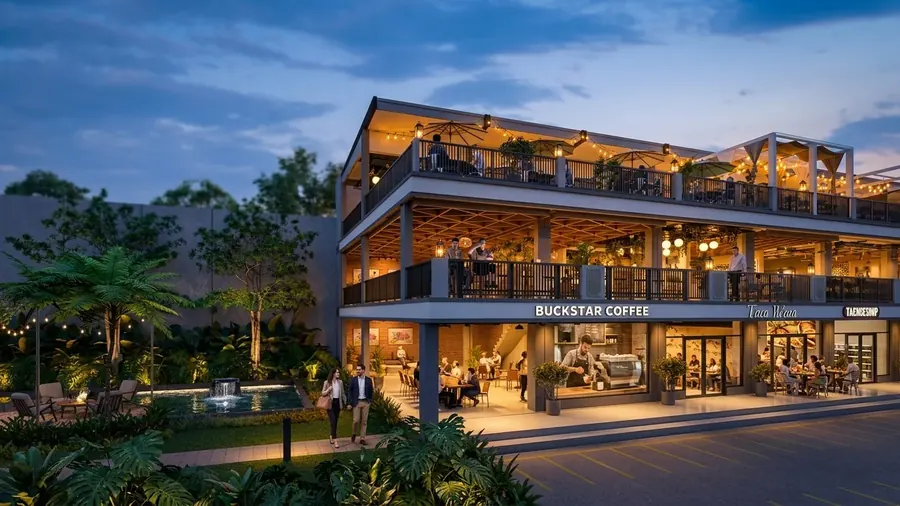
Uses a 3-storey shophouse. Ground floor central kitchen and cashier, second floor indoor seating, third floor open rooftop. Fits the Ruko Sapphire 3-storey + rooftop at 4.5 × 16 m.
Upfront is larger (IDR 600-800M), but it captures family dining + teen hangouts. Monthly revenue at IDR 220-300M for the operators who pull it off. The challenge: managing three floors requires a bigger team and tighter supervision.
Buy the Shophouse vs Rent It: 5-Year Math
Where first-time operators often miscalculate: comparing annual rent against a KPR installment for the shophouse, then concluding "buying looks cheaper." That's misleading because it ignores the opportunity cost of the down-payment capital and the working capital locked up.
A realistic Model B operator scenario in North Bekasi:
| Scheme | Cash out over 5 years | End-state asset |
|---|---|---|
| Rent at IDR 110M/year | IDR 605M | IDR 0 (operator) |
| Buy IDR 1.9B (25% DP, KPR 15 yr @ 9%) | IDR 1.38B (DP + 60 monthly installments) | IDR 2.15B (estimated property value + reduced principal) |
Buying wins if (a) you're confident the business survives at least 5 years, (b) working capital still covers 6 months of operations without extra borrowing, and (c) the location has 6-8% annual appreciation potential. Renting makes more sense for newcomers still in concept-validation phase.
Note for first-time operators: If part of your funding comes from a KPR or business loan, do not include installments in "monthly operating profit." Keep the two separate. Installments are repayment of investment capital; operating profit is the pure return on operations. Mixing them inflates ROI versus reality.
What the Perjuangan Corridor Looks Like on the Ground
Three things tend to separate operators who survive from those who close inside 12 months in North Bekasi:
A location with a clear captive market. Shophouses attached to dense residential (clusters, housing complexes) have steadier base traffic than shophouses on busy avenues with high vehicle traffic but low foot traffic. Successful cafes typically see 30-40% repeat customers from within a 1 km radius.
Differentiation you can explain in one sentence. Not "a regular cafe with good coffee" — too generic. Operators who survive have a sharp angle: kid-friendly cafe with a mini playground, single-origin Aceh specialty with brewing classes, coworking cafe with 200 Mbps internet and outlets at every table, rooftop with sunset view.
Disciplined cash management. Owners who mix operating cash with personal money almost always hit a cash-flow crisis in month 5 or 6. Separate the accounts, draw a fixed owner's salary, and set aside at least 10% of revenue as emergency reserve.
Kingspoint's Ruko Sapphire for F&B Operators
Ruko Sapphire's 4.5 × 16 m footprint (LT 72 m², LB 172 m² over 3 floors + rooftop) at IDR 1.9B suits Model B or Model C. The location on Jl. Raya Perjuangan, North Bekasi — 5 minutes to Summarecon Mall and 5 minutes to Bekasi Station — exposes you to commuter traffic plus mall-goer purchasing power.
The baseline 2200 VA electrical capacity can upgrade to 5500 VA or 7700 VA based on commercial espresso and seating-area AC requirements. The pile foundation plus stone footing supports additional loads if an operator modifies the second floor into a larger seating area.
For first-timers who want to validate a concept before committing to a purchase, there's also a take-over rental option from existing shophouses nearby. The Kingspoint team can share local market insights before any buy decision.
Want to discuss a cafe concept in Ruko Sapphire?
Our team has F&B layout concepts for the 3-storey + rooftop Sapphire, plus foot-traffic data for the Perjuangan corridor. Chat to request a layout proposal.
Discuss F&B Layout