
The Bekasi City Government has raised a plan to build a road running parallel to Jalan Mukhtar Tabrani in Bekasi Utara. The official statement is dated 13 August 2026, delivered by Bekasi Mayor Tri Adhianto during a site inspection along that corridor. In the coverage that followed, the second-lane concept picked up the nickname “Mukhtar Tabrani 2”.
Two sentences from the mayor became the core of every report. Both appear in the city government's own statement:
“Mudah-mudahan kita akan menginisiasi menjadi jalan sejajar dengan Mukhtar Tabrani.” (Hopefully we will initiate a road parallel to Mukhtar Tabrani.)
“Ke depannya konseptualnya saya rasa bisa menjadi one way di Mukhtar Tabrani.” (Going forward, conceptually I think Mukhtar Tabrani could become one-way.)
Look at the wording: hopefully, initiate, going forward, conceptually, I think. That is the language of a plan at its earliest stage, not of a project with a signed contract.
The gap between a sentence like that and a road your car can actually drive on is usually measured in years. So this article doesn't model the impact. It separates what is fact from what is still a proposal.
What has been announced versus what hasn't
Here is the breakdown, based on the Bekasi City Government's official statement of 13 August 2026 and the reporting that followed a day later:
| Component | Status as of 24 August 2026 |
|---|---|
| The parallel road concept | Officially raised by the mayor |
| One-way scheme on Mukhtar Tabrani | Described as a forward concept, tied to a counterpart route existing |
| Route and road length | Not published |
| Carriageway width | Not published |
| Budget figure and funding source | Not published |
| Technical design | Not published |
| Construction schedule and target completion | Not published |
| Which kelurahan the route crosses | Not detailed |
One item deserves separate handling. In local reporting on the same inspection, the mayor thanked affected residents and referred to demolition work being carried out shortly, which suggests some of the land side of this corridor is already moving. The official statement, though, carries no detail on how much land, at which points, or under what documents. So we're keeping that as reported coverage rather than a figure anyone can rely on.
Why "the land is moving" doesn't yet mean "the road is happening"
Land acquisition and road construction are separate budget lines, often in separate fiscal years. Land can be settled first while construction waits one, two, or several APBD cycles. Across Jabodetabek, corridors with land ready but no carriageway built are not a rare sight.
There's an extra factor this year. Infrastructure delivery across the Bekasi area in 2026 slipped once already while unit-price analyses were adjusted after construction material costs rose. When unit costs shift, the priority order of work packages gets rebuilt along with them. We traced the same pattern through the city's road budget in our note on the Bulak Kapal flyover and the Bekasi City road budget.
So the deciding question isn't whether the mayor means it. It's which planning document this package lands in, and in which fiscal year.
A one-way scheme cuts both ways for residents
If the one-way scheme does arrive, it won't land evenly on everyone along the corridor. Some trips get shorter; others get longer.
- Flow improves in the retained direction, because opposing-traffic conflict disappears.
- Trips in the other direction become detours. This is the part most often left out of the arithmetic. A house whose exit runs against the new direction picks up extra distance every day, twice a day.
- Average speeds rise, which isn't purely good news for houses sitting right at the roadside, because noise and crossing risk rise with them.
- Shopfront value shifts. A business that depends on passing trade can gain or lose, depending on which side the flow ends up running.
A one-way system only works once its counterpart route exists. That's why both ideas were raised together, and why the one-way scheme cannot arrive before the parallel road is built.
How to check the status yourself, without waiting for the next headline
Infrastructure plans tend to surface once and then go quiet for months. If you have a stake in this corridor, you can track it yourself:
- Look for the work package by name in regional planning documents. A plan that has moved up in status appears as a named activity in the Bekasi City RKPD or APBD documents, with its budget ceiling attached. Until the name appears there, it's still an idea.
- Check procurement. Packages genuinely due for the current year get posted on official procurement channels, with a ceiling value and a tender schedule. That's the most concrete signal available before heavy equipment shows up.
- Ask the technical agency. Carriageway work sits with the Bekasi City agency handling highways and water resources; traffic-direction engineering sits with the transport agency.
- For land questions, use spatial data rather than neighbourhood talk. A planned route touching specific parcels shows up in spatial planning records, and you can check that before signing anything. We set out the steps in our guide to checking zoning and land designation under the Bekasi RTRW.
A rule of thumb that applies to every infrastructure plan, not only this one: if a project has no budget ceiling and no package number, its effect on property prices is still a forecast. A seller may fairly call it potential. A buyer is better off not paying for it today.
If you're weighing a house in the Bekasi Utara corridor
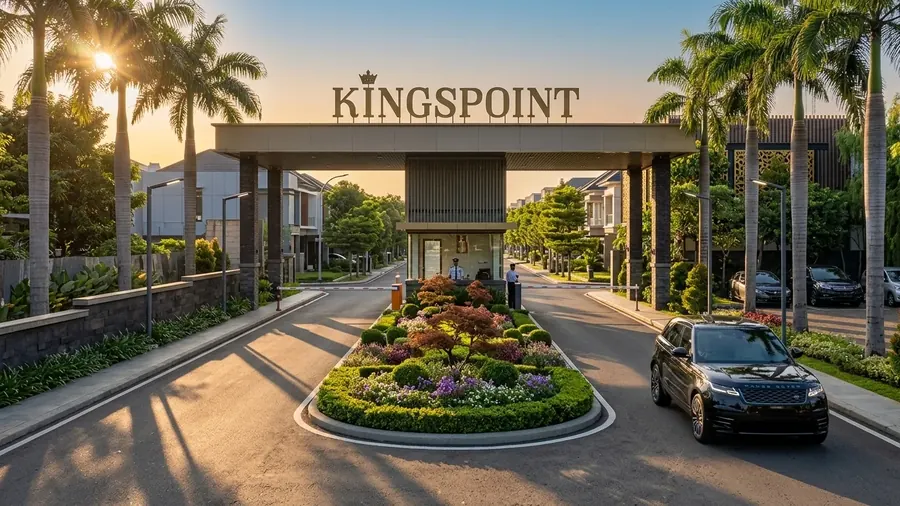
Kingspoint sits on Jl. Raya Perjuangan, Bekasi Utara — the same district as the Mukhtar Tabrani corridor, sharing the same road network toward Bekasi Station, Summarecon Mall Bekasi, and the Bekasi Barat toll gate. If this plan proceeds, traffic distribution across Bekasi Utara does change with it.
The sound way to treat it: value a house today on the access that already exists, not on access that has only been proposed. A plan that lands is a bonus. A plan that stalls, shifts route, or is dropped costs you nothing, provided the price you paid never counted it in.
What matters far more day to day: how many minutes from the cluster gate to the places you actually go, when the corridor peaks, and whether more than one exit route exists when a single stretch clogs. You can test all three yourself right now, without waiting on anyone's budget cycle.
How to weigh infrastructure against house prices, including which projects deserve a place in your arithmetic and which are brochure garnish, is something we cover separately in how Bekasi infrastructure affects property values.
Note: this article is educational and summarises the Bekasi City Government's official statement dated 13 August 2026 together with subsequent reporting. Plan status, route, budget, and schedule may change at any time and rest entirely with the Bekasi City Government. For certainty affecting a specific parcel or a purchase decision, confirm with the relevant agency.
Want to test the daily access yourself?
The Kingspoint team can walk you through the routes in and out of Jl. Raya Perjuangan toward Bekasi Station, Summarecon, and the toll gate, peak hours included, so you can judge it on the access that exists today.
Chat on WhatsApp